Why Trouser Length Alters the Whole Silhouette
See how trouser length changes the leg line and shoe relationship, then choose a trouser break that suits your footwear, fabric, and everyday outfits.
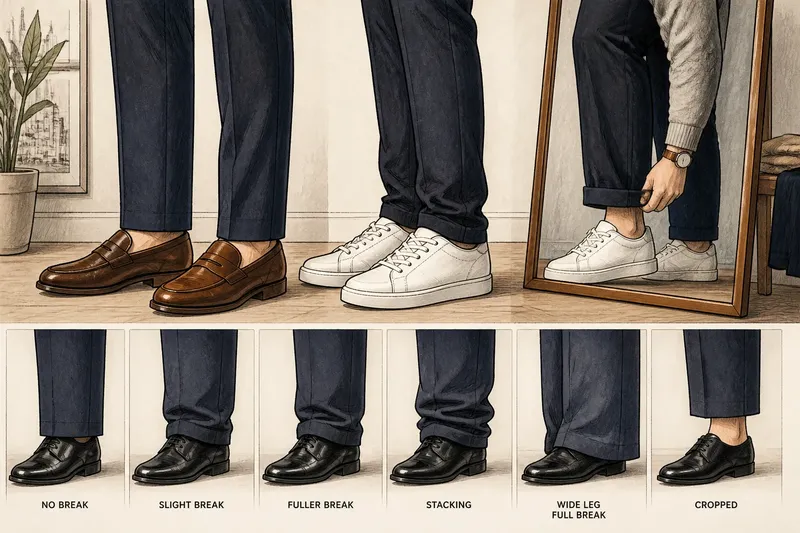
You put on navy trousers with loafers, then swap into sneakers before leaving. The hem that looked neat with the loafers now catches on the padded sneaker collar. Trouser length changes the line from leg to shoe, so it helps to judge the hem with the footwear you actually plan to wear.
Read the line from waist to shoe
Your eye travels down the trouser leg and meets the shoe at the hem. A narrow, low-profile shoe makes a quiet endpoint; a broad toe or thick sole gives that endpoint more visual weight.
A hem above the shoe leaves more footwear visible and gives the ankle a clear boundary. A hem resting on the shoe links the two shapes, while excess fabric can gather into folds. The effect is a little like a page’s last line: its position changes how the whole passage feels, even though the words above it stay put.
Recognize the main trouser breaks
A trouser break is the fold or crease that forms where the hem meets the shoe. The terms describe what the fabric is doing; they are not grades or fixed measurements.
- No break: The hem ends at or just above the shoe, with little or no fold at the front. Choose this if you want a crisp endpoint; if the ankle looks too exposed for your outfit, try a slightly longer hem.
- Slight break: A small fold forms at the front. If it softens the transition without bunching, keep it; if it piles up, shorten the hem or try a less bulky shoe.
- Fuller break: A more visible fold rests on the shoe. If the fabric looks connected to the footwear, the effect may suit a relaxed outfit; if the fold overwhelms the shoe, try a shorter hem.
- Stacking: Several folds collect above the shoe. If you want a casual, gathered look, keep the length; if the ankle looks crowded, shorten the hem or pair the trousers with a higher-volume shoe only if the proportions still feel balanced.
These names help you describe the result, not choose a winner. A sharp edge can suit a clean, tailored outfit, while a softer fold may feel more at home with relaxed trousers and substantial footwear.
Let shoe shape guide the hem
A pointed or low-profile shoe leaves a different endpoint from a rounded toe, lug sole, or high-top. A hem that falls cleanly over loafers may catch on a sneaker collar or settle heavily against a boot.
Wear the intended shoes and inspect the front, side, and back. The front shows the break, the side reveals whether cloth catches, and the back shows whether the hem rests neatly near the heel or drags underfoot.
Say you have straight-leg navy trousers and two shoes: slim loafers and broad-soled sneakers. With the loafers, the fabric makes one small fold. With the sneakers, it bunches at the padded collar. You try a temporary inward cuff while wearing the sneakers; the folds settle and the shoe collar stays clear. The tradeoff is a visibly shorter leg line, so you decide whether that cleaner ankle or the longer line matters more for the outfit.
Why does trouser width change the effect?
Do wide-leg trousers need a different length?
Wide legs carry more fabric toward the shoe, so a hem that rests on the footwear can create a continuous column. If the hem stops higher, the visible shoe and ankle become a clearer feature; choose the effect that suits the outfit.
Why do slim trousers show more shoe?
A narrow hem leaves less cloth to overlap the shoe, making the footwear easier to see. If extra length gathers rather than forming one clean fold, try a shorter hem or a shoe with a lower profile.
Can cropped trousers work with low-cut shoes?
Yes. The gap can look deliberate when the hem and shoe feel balanced, while a higher shoe fills more of the space. Compare the full outfit to see which boundary you prefer.
Should the back hem touch the ground?
The back should not drag underfoot, where cloth can catch or wear. Check the trousers while standing naturally and walking; if the hem trails or lifts in a way that bothers you, ask a tailor to assess the length.
Check how fabric moves in ordinary motion
Fluid fabric can shift around a shoe as you walk, while crisp or heavier cloth may hold a more defined edge. A hem that looks tidy while standing may feel cumbersome when you sit, climb stairs, or take a longer stride.
Wear the trousers with the intended shoes and walk across the room, sit in a chair, and take a few steps up and down if stairs are available. Notice whether the fabric catches, exposes more ankle than you want, or settles back into place. If it catches repeatedly, try another shoe or have a tailor assess the hem.
Use these observations to choose an adjustment
Before changing a hem, look at what the fabric does with the shoes you plan to wear. Each observation points to a practical choice:
- If the front hem makes one small fold, keep the length; if it forms several folds, try a temporary cuff or ask a tailor about shortening it.
- If the side hem catches on a sneaker collar, try a lower-profile shoe; if the catch remains, ask a tailor to assess the length.
- If the back hem drags underfoot, avoid wearing it that way; pin or temporarily cuff the hem and arrange a proper alteration if the change improves the result.
- If a cropped hem leaves more ankle visible than you want, pair it with a higher shoe; if that feels too heavy, choose a longer hem instead.
- If a wide leg falls smoothly onto the shoe, keep the length; if the fabric obscures the footwear, try a shorter temporary cuff before deciding on an alteration.
- If the cloth settles after walking, keep the pairing; if it stays twisted or bunched, try another shoe and reassess before altering the trousers.
For trousers worn with several shoes, compare the hem with the pair that makes the fabric bunch or catch most. A hem tailored for one shoe can behave differently with a taller upper or thicker sole.
Make the hem work for the outfit
There is no single correct trouser break. The leg shape, fabric, shoe, and intended impression all affect whether a crisp endpoint, soft fold, or longer line feels right.
For a useful comparison, keep the trousers and shoes constant while testing a temporary cuff, then return the fabric to its original position. Notice whether the ankle looks clearer, the shoe feels crowded, or the cloth settles more smoothly. This makes “the length feels off” a specific observation you can use to decide whether to change the footwear or consult a tailor.
Trouser length is easiest to judge by the relationship between hem, fabric, and shoe, not by an abstract ideal. When you search for trouser length advice, look for guidance that accounts for the shoes you wear and how the fabric behaves in motion. That small distinction can help you choose an adjustment you will be comfortable wearing.